

 Dispatch
 Cloud
CloudIntroduction: The delayed unification of digital commerce
A vision deferred: the fifteen-year arc
Fifteen years ago, I believed the trajectory of digital commerce was destined for a singular, consolidated fate. To me, the technological landscape was fracturing rapidly; the desktop monopoly had shattered, giving way to the mobile web, native applications, and the nascent experiments of Google Glass and early IoT devices. In my view, for independent brands and retailers, this multiplication of channels represented a terrifying escalation in technical complexity. To sell effectively, I thought a merchant needed not just a website, but a mobile-responsive design, an iOS app, an Android app, and integrations with a growing roster of marketplaces. At that specific juncture, it seemed inevitable to me that the friction of maintaining proprietary web properties would become insurmountable for all but the largest conglomerates. The prevailing hypothesis among forward-thinking analysts was that independent brands would retreat from the “storefront” model entirely. Instead of maintaining complex, customer-facing technical stacks, I believed brands would evolve into pure catalog providers—content and logistics nodes feeding into massive, centralized distributors like Amazon, Google Shopping, and emerging marketplaces. My expectation was that the user interface, the “shop”, would decouple completely from the merchant, centralized by tech giants who could master the fragmented device landscape better than any single retailer. That consolidation did not happen. My hypothesis was wrong. Or at least, premature. Instead, the opposite occurred. The last decade saw the explosion of Direct-to-Consumer (DTC) brands, powered by the democratization of “headless” commerce infrastructure. Platforms like Shopify, BigCommerce, and flexible PaaS solutions empowered merchants to maintain their own unique digital identities. The proliferation of channels did not force consolidation; it fostered a diverse, albeit fragmented, ecosystem where the brand website remained the sun around which marketing orbits revolved. Humans, it turned out, valued the brand experience, the storytelling, and the direct connection enough to navigate to brand.com rather than buying everything through a centralized aggregator interface.The arrival of the agentic era
We are now standing at the precipice of the shift that was predicted a decade and a half ago. The catalyst, however, is not a new device form factor like “smart glasses,” but a fundamental change in the nature of the buyer itself. We are entering the era of Agentic Commerce, where the primary entity navigating the web is no longer a human clicking links, but an autonomous Artificial Intelligence (AI) agent executing tasks. The rise of agentic systems, powered by Large Language Models (LLMs) and standardized interaction protocols, is finally forcing the unification of the e-commerce ecosystem. Unlike the device fragmentation of 2010, which brands could overcome with responsive design, the agentic shift fundamentally alters the mechanism of commerce. An AI agent does not care about your brand’s font choice, your hero banner’s emotional resonance, or your carefully curated “About Us” page. It cares about structured data, API latency, inventory accuracy, and semantic relevance. This shift validates the fifteen-year-old prediction: the interface is finally decoupling from the inventory. When a user asks an advanced agent to “find me a red waterproof hiking jacket under $200 that can be delivered to Denver by Friday,” the agent does not visit five websites to browse. It queries a network of data sources, negotiates capability, and executes a transaction. In this world, the merchant’s “web property” becomes less of a visual destination for humans and more of a structured data source for machines.The view from Upsun: Traffic patterns in transition
As a cloud application platform powering thousands of e-commerce workloads, Upsun occupies a unique vantage point to observe this transition in real-time. We are witnessing a definitive structural shift in traffic composition. In 2024, automated bot traffic surpassed human-generated traffic for the first time in a decade, accounting for 51% of all internet traffic. While a significant portion of this remains “bad bots” (credential stuffers, inventory hoarders, and DDoS actors) a rapidly growing segment is “agentic traffic”. Adobe Analytics data reveals that traffic to U.S. retail sites from generative AI browsers and chat services surged by 4,700% year-over-year in July 2025. This is not merely “more traffic”; it is a different kind of traffic. Human traffic is browsing-heavy, read-intensive, and highly cacheable. Agent traffic is query-heavy, often transactional, and computationally expensive. The “use case” of the e-commerce website is evolving from a digital catalog for humans to an API endpoint for autonomous agents. The introduction of the Universal Commerce Protocol (UCP) by Google, in collaboration with Shopify and other retail giants, is the infrastructure response to this reality. It provides the “common language” required for these bots to be efficient, reducing the hallucinations that plague LLM-based shopping today. However, while UCP solves the interoperability problem, it introduces profound new challenges for merchant infrastructure, resource management, and strategic independence.The Universal Commerce Protocol (UCP): A technical deep dive
Solving the N-to-N integration problem
To understand UCP, one must first understand the bottleneck it resolves. In the nascent days of AI commerce, an agent (like ChatGPT or Gemini) desiring to purchase a product from a merchant (like a Shopify store or a custom Magento build) faced an “N x N” integration problem.- The Agent’s Problem: To shop at 1,000 different stores, the agent needed to understand 1,000 different checkout flows, API schemas, and authentication methods.
- The Merchant’s Problem: To sell on every emerging AI surface (ChatGPT, Perplexity, Gemini, Claude), the merchant needed to build and maintain bespoke integrations (MCP, API’s, etc.) for each platform.
The architecture of agentic interaction
UCP is not a single API but a suite of specifications designed to modularize the commerce journey. Its architecture rests on three primary pillars: Services, Capabilities, and Extensions.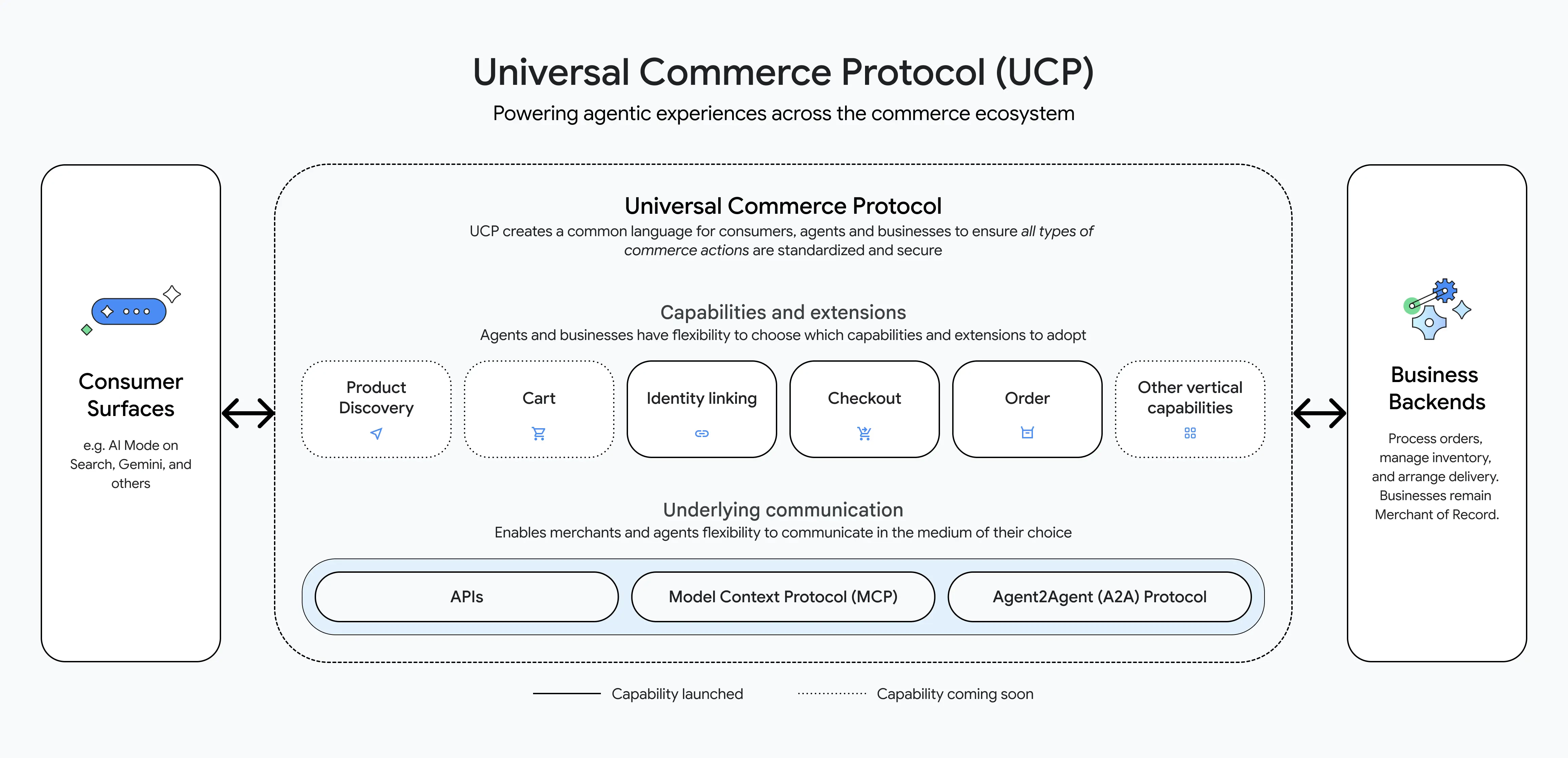
Services and discovery
The entry point for any UCP interaction is the Discovery Manifest. Merchants utilizing UCP publish a standardized JSON file at a “well-known” endpoint:/.well-known/ucp. This is the digital handshake.
When an AI agent encounters a merchant’s domain, it requests this file to understand “what language this shop speaks.” The manifest declares:
- Supported Services: High-level domains like
dev.ucp.shoppingordev.ucp.travel. - Versions: Ensuring backward compatibility as the protocol evolves.
- Payment Configurations: Which payment handlers (e.g., Stripe, Shop Pay) are accepted.
Capabilities: the atomic units of commerce
Capabilities define the functional primitives of the interaction. Thedev.ucp.shopping service, for example, is composed of several core capabilities:
- Product Discovery: A standardized schema for searching inventory. Unlike traditional SEO schema (which is passive), this capability allows for active querying of stock levels and variants.
- Cart Management: APIs for creating a session, adding line items, and updating quantities.
- Checkout: The complex logic of tax calculation, shipping selection, and finalizing the order.
- Order Management: Webhooks and endpoints for tracking status (shipped, delivered, returned)
Extensions: handling retail complexity
Retail is messy. A furniture store selling custom sofas has fundamentally different requirements than a digital goods store selling software keys. UCP handles this variance through Extensions.- Fulfillment Extensions: Allow negotiation of delivery windows (“Tuesday between 2-4 PM”) or pickup locations.
- Discount Extensions: Enable the application of promo codes or loyalty points logic during the checkout negotiation.
- Identity Extensions: Facilitate linking a user’s Google or Apple ID with their merchant loyalty account using OAuth 2.0 patterns.
The transport layer: agnosticism in action
A critical innovation of UCP is its transport agnosticism. It defines the structure of the data but is flexible regarding how that data moves.- REST APIs: The most common binding for web infrastructure, allowing standard HTTP POST/GET requests to drive agent actions.
- Model Context Protocol (MCP): A breakthrough standard for LLMs. MCP allows an AI model to “see” the merchant’s UCP endpoints as “tools” it can invoke. Instead of hallucinating a checkout URL, the model calls the checkout() tool defined via MCP, ensuring deterministic execution.
- Agent2Agent (A2A): This protocol facilitates direct negotiation between a “Buyer Agent” (acting for the consumer) and a “Seller Agent” (acting for the merchant). In high-value B2B scenarios, A2A allows agents to haggle over price or bulk terms without human intervention.
The payment layer: splitting instruments and handlers
Perhaps the most technically sophisticated component of UCP is its payment architecture. To solve the trust issue “How do I let a bot spend my money?” UCP separates Payment Instruments from Payment Handlers.- Instruments: The method of payment (e.g., a specific credit card, a tokenized wallet credential).
- Handlers: The processor (e.g., Stripe, Adyen, PayPal).
"up to \$100 at Target." The agent passes this cryptographic proof to the merchant’s handler. The handler verifies the signature and processes the funds.
This “Security-First” design ensures that the merchant remains the Merchant of Record (MoR), retaining liability and control, while the agent acts merely as a secure courier for the user’s intent.
The infrastructure shift: From human browsing to machine execution
For Upsun engineers and customers, the adoption of UCP implies a radical shift in system architecture and resource utilization. The traffic patterns of 2026 will bear little resemblance to those of 2016.The decline of the cache hit
For twenty years, e-commerce scalability relied on a simple premise: Read-Heavy / Write-Light.Humans browse aggressively. They view category pages, product detail pages (PDPs), and “About Us” sections. This content is static or semi-static. It lives in the Edge Cache (CDN). When a flash sale hits, 99% of the traffic is absorbed by Varnish or Fastly, with only the final “Add to Cart” and “Checkout” requests hitting the origin database. Agentic Commerce inverts this ratio. An AI agent does not “browse” visual pages. It does not load high-resolution hero images, CSS files, or JavaScript bundles. It queries data directly via API.
- The request:
POST /ucp/search { "query": "running shoes", "size": "10", "delivery\_max\_days": 2 } - The reality: This request is dynamic. It requires a real-time database query to check inventory levels across multiple warehouses to confirm the 2-day delivery constraint. It cannot be served from a static cache.
- Throughput vs. Bandwidth: Bandwidth usage (serving images) may decrease, but CPU and Memory usage (processing JSON logic) will spike.
- Database Pressure: Real-time inventory checks by thousands of agents simultaneously will create “hot rows” in databases. The “Thundering Herd” problem, previously limited to DDoS attacks, becomes a standard operating condition of agent-based shopping.
The “Thundering Herd” of agents
Consider the mechanics of an AI shopping assistant. A user asks, “Find the best price for a Sony A7V camera.” The agent instantly queries 50 different retailers simultaneously to compare pricing and shipping.- Simultaneity: Unlike human traffic, which ramps up (users wake up, log on), agent traffic is bursty and instantaneous. A single user query triggers 50 concurrent API calls to 50 different merchants.
- Retry Logic: If an API endpoint is slow (latency > 200ms), agents may be programmed to time out and retry or abandon. Machine tolerance for latency is far lower than human tolerance.
Semantic caching: the new performance frontier
If traditional URL-based caching fails for dynamic agent queries, what replaces it? The answer is Semantic Caching.- The Problem: Query A (“Red dress”) and Query B (“Crimson evening wear”) are different strings but semantically similar. A standard cache treats them as unique misses.
- The Solution: Infrastructure must implement Vector Databases (like Qdrant or pgvector on Upsun) to cache the meaning of a request. If the agent asks a question that is semantically close to a cached result, the system can serve the cached JSON without hitting the primary SQL database.
The resource usage shift: metrics table
Strategic implications for retailers: adapting to the machine customer
The shift to UCP is not just a technical upgrade; it is a rewriting of the rules of retail engagement. For independent merchants, this presents a paradox of opportunity and existential risk.The “Great Decoupling”: Zero-Click Commerce
Gartner predicts a 25% decline in traditional search volume by 2026 as users shift to AI assistants. This phenomenon, known as “The Great Decoupling,” means that purchase intent is being captured and fulfilled within the AI interface.- The Old World: User searches Google -> Clicks link -> Visits brand.com -> Buys.
- The Agentic World: User asks Gemini -> Agent negotiates via UCP -> Transaction completes in Gemini.
Data as the new storefront
In an agentic world, your Products Catalog Feed is your storefront.If an agent cannot parse your return policy, shipping window, or stock level via structured UCP data, your product effectively may not exist. The visual appeal of your site matters zero to an algorithm.
- Fulfillment Data: Agents prioritize certainty. A merchant who exposes “3-5 day shipping” (vague) will lose to a merchant who exposes a precise “Delivery by Thursday 4 PM” via UCP’s fulfillment extension. The Third Party Logistics integration becomes a marketing asset.
- Inventory Accuracy: If an agent attempts to buy a product that turns out to be out-of-stock, it learns. The “reliability score” of that merchant may drop, and the agent will deprioritize them in future queries. Inventory accuracy is now an GEO/SEO ranking factor.
Generative Engine Optimization (GEO): on top of SEO
Just as merchants spent the last decade mastering SEO (keywords, backlinks), they must now master GEO (Generative Engine Optimization).- Optimization Goal: To be the “cited source” or the “recommended product” in an LLM’s answer.
- Tactics: This requires “fact-dense” content. Vague marketing fluff (“The best in class!”) would be ignored by LLMs. Specific, structured attributes (“Made of 100% merino wool, 200gsm weight, ethical source certified”) are prioritized.
- Structured Data: Implementing comprehensive
Schema.orgmarkup and UCP manifests is the prerequisite for GEO visibility.
The Bidding War: ad placement in the agent age
The most ominous question for independent merchants is: How does an agent decide?When a user says “Buy me detergent,” and the agent has 50 valid UCP options, which one does it choose?
- Algorithmic Bias: Currently, agents optimize for user constraints (price, speed).
- The Future: It is inevitable that this decision layer will be monetized. I am pretty sure we will see the rise of Agentic Bidding. Merchants will bid not for a banner ad, but for the agent’s preference.
- “Direct Offers”: Google is already piloting “Direct Offers” in AI Mode, allowing merchants to inject discounts directly into the chat stream when high intent is detected. This is the precursor to a Cost-Per-Recommendation (CPR) ad model.
The Merchant of Record: a double-edged sword
UCP explicitly maintains the brand as the Merchant of Record (MoR).- The Good News: You own the customer data. You own the transaction. You are not just a supplier to Amazon; you are the seller.
- The Bad News: You own the liability. If the AI agent hallucinates a feature (“This watch is waterproof to 100m” when it is only 30m) and the user buys it, you process the return. You eat the chargeback risk. The separation of the “sales agent” (Google) from the “responsible party” (Merchant) creates a liability gap that legal frameworks have yet to address.
Challenges and risks: navigating the transition
The “surgical” shopper and margin compression
Data from Cyber Week 2025 shows that AI-driven shoppers are “surgical.” They are value-focused, precision-oriented, and more immune to impulse buys.- Loss of Upsell: In a traditional checkout, you can display “Customers also bought…” to boost Average Order Value (AOV). In an agentic transaction, the agent buys exactly what was requested and nothing else.
- Margin Erosion: Agents are ruthless price comparers. They can check 50 sites in 100ms to find the lowest price. This commoditizes goods and pressures margins for retailers who cannot differentiate on service, branding or exclusivity.
Ecosystem control and fees
While UCP is “open source,” its ecosystem is dominated by giants. Google, Shopify, and Stripe are the primary architects.- Dependency: Small merchants may find implementation too complex, forcing them to rely on platforms like Shopify to handle UCP. This deepens the “platform tax.”
- Payment Fees: The modular payment handler system is elegant, but it ensures that payment processors (and the platforms embedding them) continue to extract their percentage. There is a risk that “Agentic Fees” will be layered on top of transaction fees, similar to how app stores operate today.
Technical debt
Implementing UCP requires a level of API maturity that many legacy retailers lack. Real-time inventory syncing, webhook-based order management, and tokenized payment flows are non-trivial engineering challenges. Merchants stuck on legacy monolithic ERPs will find themselves locked out of the agentic economy until a complete rewrite.Upsun recommendations: engineering for the future
For the developer community and business leaders on Upsun, the roadmap is clear. We must build infrastructure that is Agent-Ready.Architectural Recommendations
- Prioritize Horizontal Scaling: Move away from “big iron” servers. Configure your Upsun applications to scale horizontally (adding more containers) rather than vertically. Agent traffic is bursty; your infrastructure must be elastic.
- Implement Vector Caching: Explore adding Qdrant or pgvector services to your Upsun stack. Implementing a semantic cache layer will protect your primary database from the query load of thousands of agents.
- Adopt API-First Principles: Ensure your product catalog and inventory systems are exposed via performant, RESTful APIs. The UCP manifesto is essentially a mandate for API-first commerce.
Operational Strategy
- Publish the Manifest: Create and host the
/.well-known/ucpfile. Even if you are not fully ready for transactional agents, enabling Discovery capabilities ensures your products are visible to the new search crawlers. - Use Preview Environments for Agent Testing: One of Upsun’s core features, Preview Environments, is the perfect sandbox for this new world. You can clone your production environment, unleash a test swarm of AI agents against it, and verify how your APIs handle the load without risking your live site. This “Production Clone” capability is your safety net for testing UCP integrations.
- Security Configurations: Update your Web Application Firewall (WAF) rules. You must distinguish between “good agents” (UCP-compliant, authenticated via headers) and “bad scrapers.” Rate limiting should be intelligent, not blanket.
Conclusion: the new frontier of commerce
The Universal Commerce Protocol is not merely a technical specification; it is the constitution of a new digital economy. It confirms that the future of commerce is unified, automated, and mediated by software. Independent merchants are not dead. UCP gives you a fighting chance to be discoverable and transactable in an AI-dominated world without surrendering your data to a walled garden. You remain the Merchant of Record. You own the customer. But the bar for technical competence has been raised. The “storefront” is no longer a visual experience you control; it is a data stream you must optimize. The competition is no longer local; it is algorithmic. And the intermediaries (Google, Shopify, the payment networks) have solidified their position as the toll-takers of this new highway. For the independent merchant, the path forward is to embrace the protocol. Fight for data accuracy. Optimize for the machine customer. And leverage flexible, scalable infrastructure like Upsun to handle the “thundering herd” of agents that are coming to shop. The agentic era has arrived. The question is not whether you will participate, but whether you will be ready when the agents come knocking.Glossary of terms
- UCP (Universal Commerce Protocol): The open standard for agent-merchant interoperability.
- MoR (Merchant of Record): The entity legally responsible for the transaction and customer data.
- GEO (Generative Engine Optimization): Optimizing content to be cited/recommended by AI models.
- MCP (Model Context Protocol): A standard for LLMs to connect to external data tools.
- AP2 (Agent Payments Protocol): A protocol for delegating secure payment authority to agents.
- A2A (Agent2Agent): A protocol for autonomous negotiation between software agents.
Works cited
- Agentic Commerce Impact Could Reach $385 Billion by 2030 | Morgan Stanley, accessed January 12, 2026, https://www.morganstanley.com/insights/articles/agentic-commerce-market-impact-outlook
- Agentic Commerce How AI Agents Are Transforming Online Buying, accessed January 12, 2026, https://www.livemint.com/focus/agentic-commerce-how-ai-agents-are-transforming-online-buying-11768029990660.html
- AI-Driven Bots Surpass Human Traffic - Bad Bot Report 2025 - Thales CPL, accessed January 12, 2026, https://cpl.thalesgroup.com/about-us/newsroom/2025-imperva-bad-bot-report-ai-internet-traffic
- Examining AI Agent Traffic: Powering the Shift to Agentic Commerce - HUMAN Security, accessed January 12, 2026, https://www.humansecurity.com/learn/blog/ai-agent-statistics-agentic-commerce/
- Generative AI-Powered Shopping Rises with Traffic to U.S. Retail Sites - Adobe for Business, accessed January 12, 2026, https://business.adobe.com/blog/generative-ai-powered-shopping-rises-with-traffic-to-retail-sites
- Ecommerce Trends: Adobe saw generative AI-powered shopping rise 4700% in July, accessed January 12, 2026, https://www.digitalcommerce360.com/2025/08/21/adobe-generative-ai-powered-shopping-data-july-2025/
- Google Universal Commerce Protocol (UCP) Guide, accessed January 12, 2026, https://developers.google.com/merchant/ucp
- Under the Hood: Universal Commerce Protocol (UCP) - Google for Developers Blog, accessed January 12, 2026, https://developers.googleblog.com/under-the-hood-universal-commerce-protocol-ucp/
- Building the Universal Commerce Protocol (2026) - Shopify Engineering, accessed January 12, 2026, https://shopify.engineering/UCP
- Universal Commerce Protocol could make checkout buttons obsolete - PPC Land, accessed January 12, 2026, https://ppc.land/universal-commerce-protocol-could-make-checkout-buttons-obsolete/
- The New Fulfillment Data Layer: What UCP Means for 3PLs, accessed January 12, 2026, https://www.fulfill.com/blog-posts/ucp-fulfillment-data-layer-3pl-guide
- Universal-Commerce-Protocol/ucp - GitHub, accessed January 12, 2026, https://github.com/Universal-Commerce-Protocol/ucp
- How the Model Context Protocol (MCP) Works - Lucidworks, accessed January 12, 2026, https://lucidworks.com/blog/how-the-model-context-protocol-works-a-technical-deep-dive
- Meet A2A: Google’s Agent-to-Agent Protocol Explained for Developers | by Parv Bhargava, accessed January 12, 2026, https://bhargavaparv.medium.com/meet-a2a-googles-agent-to-agent-protocol-explained-for-developers-24120d1cafff
- Agent to agent, not tool to tool: an engineer’s guide to Google’s A2A protocol - WorkOS, accessed January 12, 2026, https://workos.com/blog/engineers-guide-to-googles-a2a-protocol
- Announcing Agent Payments Protocol (AP2) | Google Cloud Blog, accessed January 12, 2026, https://cloud.google.com/blog/products/ai-machine-learning/announcing-agents-to-payments-ap2-protocol
- Shopware PaaS performance guide for scalable stores | Upsun, accessed January 12, 2026, https://upsun.com/blog/shopware-performance-guide/
- AI Agent Is Hitting Your APIs - Are You Ready? - Speedscale, accessed January 12, 2026, https://speedscale.com/blog/ai-agent-is-hitting-your-apis-are-you-ready/
- How to Prepare for Agentic Commerce: The 9-Step Framework for AI-Driven Shopping, accessed January 12, 2026, https://www.humansecurity.com/learn/blog/how-to-prepare-for-agentic-commerce/
- Autoscaling | Upsun Docs, accessed January 12, 2026, https://docs.upsun.com/manage-resources/autoscaling.html
- The Hidden Cost of AI Agents: A Caching Solution - DZone, accessed January 12, 2026, https://dzone.com/articles/the-hidden-cost-of-ai-agents-a-caching-solution
- CDNs are central to enhancing the delivery of AI-augmented customer experiences, accessed January 12, 2026, https://itbrief.asia/story/cdns-are-central-to-enhancing-the-delivery-of-ai-augmented-customer-experiences
- 2025 Organic Traffic Crisis: Zero-Click & AI Impact Analysis Report - The Digital Bloom, accessed January 12, 2026, https://thedigitalbloom.com/learn/2025-organic-traffic-crisis-analysis-report/
- Generative Engine Optimization Strategies (GEO) for 2026 - Go Fish Digital, accessed January 12, 2026, https://gofishdigital.com/blog/generative-engine-optimization-strategies/
- Agentic payments: a new frontier in digital commerce - Kearney, accessed January 12, 2026, https://www.kearney.com/industry/financial-services/article/agentic-payments-a-new-frontier-in-digital-commerce
- AI-Based Bidding is the Future of Advertising - Catalina, accessed January 12, 2026, https://www.catalina.com/perspectives-blog/ai-advertising-bidding-future-media-buying
- New tech and tools for retailers to succeed in an agentic shopping era - Google Blog, accessed January 12, 2026, https://blog.google/products/ads-commerce/agentic-commerce-ai-tools-protocol-retailers-platforms/
- Agentic Commerce is a Huge Opportunity for Retailers; it’s Also a Liability Storm, accessed January 12, 2026, https://www.retailtouchpoints.com/features/executive-viewpoints/agentic-commerce-is-a-huge-opportunity-for-retailers-its-also-a-liability-storm
- Cyber Week 2025: The Rise of Agentic Commerce and the Surgical Shopper - CMS Wire, accessed January 12, 2026, https://www.cmswire.com/customer-experience/cyber-week-2025-the-rise-of-agentic-commerce-and-the-surgical-shopper/
- Agentic commerce: Promise, paradox and the path forward - Worldpay, accessed January 12, 2026, https://www.worldpay.com/en/insights/articles/agentic-commerce-paradox-and-promise
- The Rise of Agentic Commerce Platforms in 2025 - BigCommerce, accessed January 12, 2026, https://www.bigcommerce.com/blog/agentic-commerce-platforms/
- Need more juice? Scaling made simple | Upsun, accessed January 12, 2026, https://upsun.com/blog/scaling-demo/
- Unlocking Edge AI: A Deep Dive into the Blackbox Projects PostgreSQL Remote MCP Server - Skywork.ai, accessed January 12, 2026, https://skywork.ai/skypage/en/unlocking-edge-ai-blackbox-postgresql/1978331891706273792
- Real-world data makes AI agents reliable - Upsun, accessed January 12, 2026, https://upsun.com/blog/ai-agent-testing-production-clone/