

The bandwidth billing challenge
When deploying infrastructure across multiple AWS availability zones (AZs), bandwidth costs can become a significant operational expense. Some of our Upsun infrastructure spans three AZs for high availability, but this architecture created an unexpected challenge with our Ceph-based storage system. Since Ceph distributes data across the cluster and AWS bills for inter-AZ traffic, approximately two-thirds of our disk I/O traffic crossed AZ boundaries—generating substantial bandwidth charges. With all disk operations flowing over the network rather than accessing local storage, we needed a solution that could reduce this costly network traffic without compromising our distributed storage benefits.The local SSD caching experiment
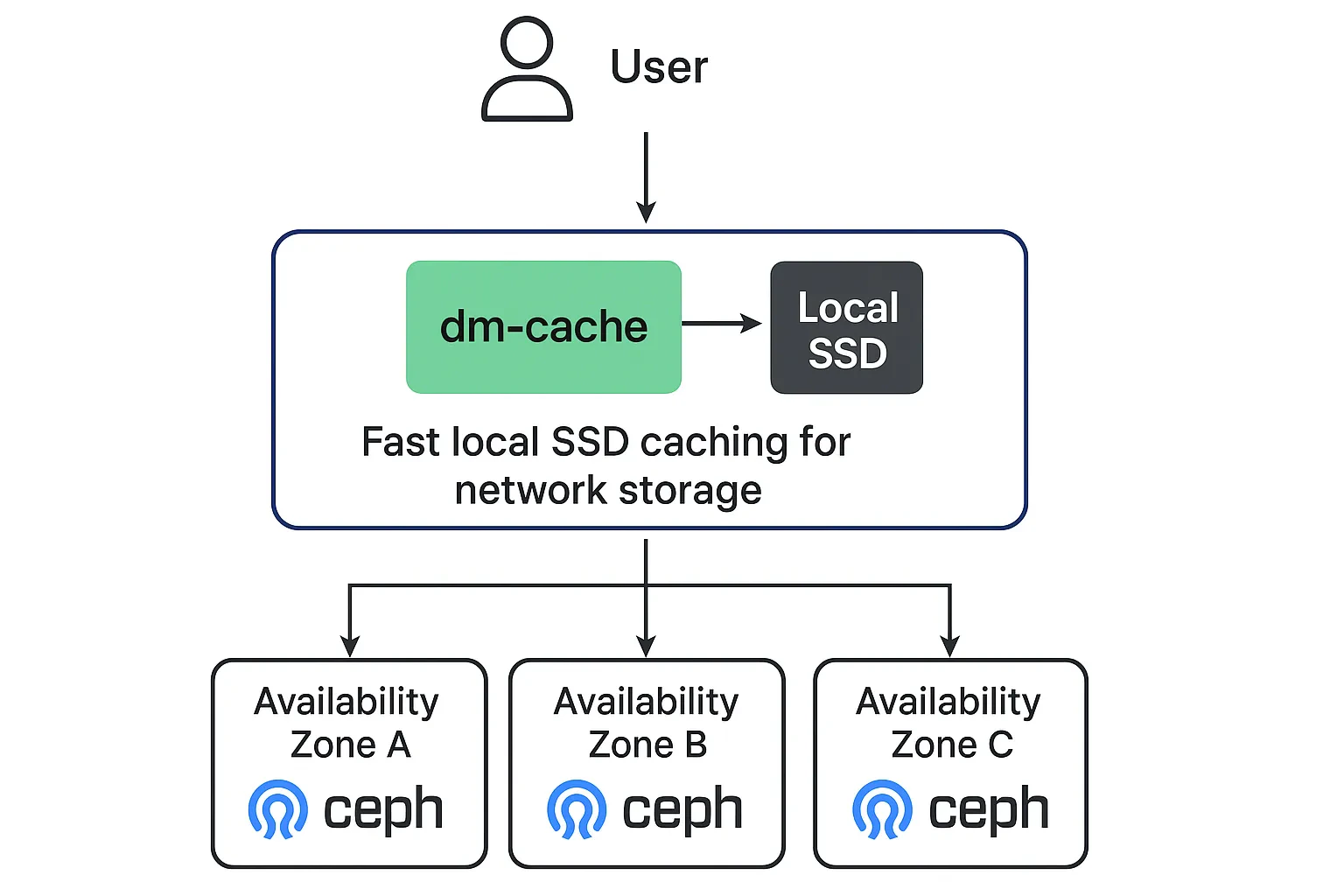
Our AWS instance types included small amounts of local SSD storage that weren’t being utilized for primary storage. This presented an opportunity: what if we could use these fast, local disks as a read cache in front of our network-based Ceph storage? We implemented a three-step caching strategy using Linux device mapper (dm-cache):- Volume partitioning: Used LVM to split the local SSD into small 512MB cache volumes
- Read-only caching: Configured dm-cache to place these volumes in front of our Ceph RBD (RADOS Block Device) volumes, caching reads while passing writes directly through to the network storage
- Container integration: Exposed the dm-cache devices to our containers as their primary storage interface
Understanding dm-cache architecture
Implementation considerations
When implementing dm-cache in production environments, consider these key factors: Cache sizing: While our 512MB cache proved effective, the optimal size depends on your application’s working set. Monitor cache hit rates and adjust accordingly. Write policy: We chose write-through mode exclusively, where all writes bypass the cache and go directly to network storage. This decision was crucial for Upsun because we host thousands of e-commerce applications where data integrity is non-negotiable. In e-commerce environments, every transaction—whether it’s inventory updates, order processing, or payment confirmations—must be immediately persisted to durable storage. A lost write due to cache failure could mean:- Customer orders disappearing after payment processing
- Inventory miscounts leading to overselling
- Financial transaction data corruption
- Regulatory compliance violations
- Cache device failure: Unwritten data in the cache would be permanently lost
- Power failures: Cached writes might not survive unexpected shutdowns
- Split-brain scenarios: Cache and storage could become inconsistent during network partitions
Results: dramatic performance and cost improvements
The impact exceeded our expectations. With cache volumes of only 512MB serving RBD volumes ranging from 5-50GB, we achieved:- 95% reduction in read traffic over the network
- 30x improvement in IOPS for cached operations
- 50% reduction in read latency
- 30x increase in read bandwidth for frequently accessed data