{authors.length > 0 &&
}
{authors.map(slug => {
const {name, url, avatarUrl} = resolveAuthor(slug);
const inner = <>
{avatarUrl &&  }
{name}
;
return url ?
{inner}
: {inner};
})}
}
{name}
;
return url ?
{inner}
: {inner};
})}
}
{authors.length > 0 && formattedDate && }
{formattedDate && {formattedDate}}
 **PostgreSQL (also known as Postgres).** Free and open-source relational database management system that emphasizes extensibility and technical standards compliance. It’s designed to handle a range of workloads, from single machines to data warehouses or web services with many concurrent users.
 **MongoDB.** Cross-platform document-oriented database program. Classified as a NoSQL database program, MongoDB uses JSON-like documents with schema.
 **Elasticsearch.** A search engine based on the Lucene library. Elasticsearch provides a distributed, multitenant-capable, full-text search engine, with an HTTP web interface and schema-free JSON documents. Elasticsearch is developed in Java.
### Eclipse MicroProfile implementations
The relatively new MicroProfile community dedicates itself to optimizing the Enterprise Java mission for microservice-based architectures. Their goal? A microservices application platform that’s portable across multiple runtimes. Currently, IBM, Red Hat, Tomitribe, Payara, the London Java Community (LJC), and SouJava lead the pack in this group.
**Elasticsearch.** A search engine based on the Lucene library. Elasticsearch provides a distributed, multitenant-capable, full-text search engine, with an HTTP web interface and schema-free JSON documents. Elasticsearch is developed in Java.
### Eclipse MicroProfile implementations
The relatively new MicroProfile community dedicates itself to optimizing the Enterprise Java mission for microservice-based architectures. Their goal? A microservices application platform that’s portable across multiple runtimes. Currently, IBM, Red Hat, Tomitribe, Payara, the London Java Community (LJC), and SouJava lead the pack in this group.
 **Thorntail** offers an innovative approach to packaging and running Java EE applications by packaging them with just enough of the server runtime to "java -jar" your application.
 **Payara Micro** Less than 70MB in size, open source, lightweight middleware platform of choice for containerized Java EE (Jakarta EE)—microservices deployments requires no installation or configuration and no need for code rewrites.
 **KumuluzEE** develops microservices with Java EE/Jakarta EE technologies and extends them with Node.js, Go and other languages. It migrates existing Java EE applications to microservices and cloud-native architecture.
 **Apache TomEE** is the Eclipse MicroProfile flavor that uses several Apache Project flavors, including Apache Tomcat and Apache OpenWebBeans.
## Join technologies together
**Apache TomEE** is the Eclipse MicroProfile flavor that uses several Apache Project flavors, including Apache Tomcat and Apache OpenWebBeans.
## Join technologies together
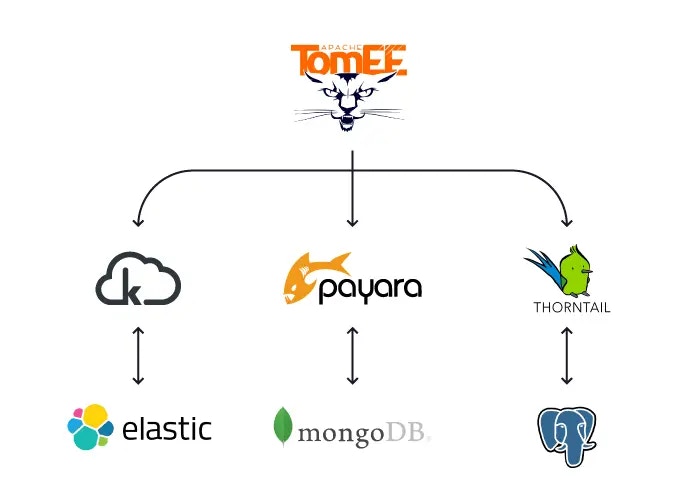 Our project has four components:
* KumuluzEE will handle the Session microservice. Users will want to search for session details, such as finding sessions that talk about either Eclipse Microprofile or Jakarta EE. To work with this requirement, the project will use a NoSQL that’s also a powerful search engine (yes, we're talking about Elasticsearch).
* Thorntail will handle the Speaker microservice, the most uncomplicated service that will manage the speaker information. This service will work with PostgreSQL.
* Payara Micro will handle the Conference microservice. This service is strongly related to KumuluzEE and Thorntail. To create a conference, we need both sessions and speakers. MongoDB seems to fit easily with this service because we can use the concept of subdocuments to put a list of presentations and speakers into the Conference entity, instead of making the relationship as in a relational database.
* Apache TomEE is the client browser using HTML 5 as the front end.
## Eclipse MicroProfile and Jakarta to the rescue
The significant benefits of the Eclipse MicroProfile? Well, first, it uses standards on Jakarta EE, such as CDI, JAX-RS, and JSON-P.
To connect to PostgreSQL or any relational database, there’s a [JPA](https://projects.eclipse.org/projects/ee4j.jpa) specification that describes the management of relational data in applications using the Java platform. To communicate to the NoSQL databases, we'll use the [Jakarta NoSQL](https://projects.eclipse.org/projects/ee4j.nosql) specification (not a final version yet, but hopefully will come out soon).
On the client-side, we'll use [Eclipse Krazo](https://projects.eclipse.org/projects/ee4j.krazo) with an [HTML 5](https://developer.mozilla.org/en-US/docs/Web/Guide/HTML/HTML5) extension, using [Thymeleaf](https://www.thymeleaf.org/) as the template engine. At the moment, the client doesn’t have a database; it will only communicate with the services to organize the values, then show them in the browser. Therefore, it will use [Eclipse MicroProfile Rest Client](https://github.com/eclipse/microprofile-rest-client), which provides a type-safe approach to invoke RESTful services over HTTP.
## Layers, layers, and more layers
The number of layers in an application is always a colossal discussion when we talk about microservices. Layers are essential to split responsibility and write clean code, while maintaining the several patterns built following this approach, like the [MVC](https://www.tutorialspoint.com/mvc_framework/mvc_framework_introduction).
However, a vast number of layers is also hard to keep and to maintain; we need to pay attention to the delay layers. Otherwise, instead of an MVC, we're creating the onion pattern, where you cry each time you go through a layer. There is no magic formula to determine the number of layers you’ll need. Rather, it will be based on the complexity of the business rules, and how the infrastructure code can give us the [cleanest architecture](https://pusher.com/tutorials/clean-architecture-introduction).
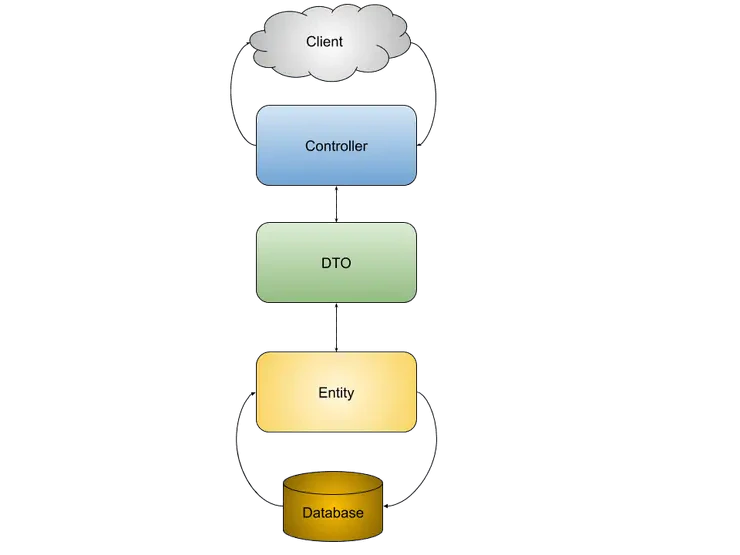
In our sample, we have three layers:
* The [entity](https://static.olivergierke.de/lectures/ddd-and-spring/#ddd.building-blocks.entites). The first instance of the business and where the domain lives. These entities, for best practice, should follow a [rich model](https://dzone.com/articles/designing-a-bulletproof-code). We can make [these entities agnostic to a database](https://dzone.com/articles/orms-heroes-or-villains-indoors-the-architecture), but this time, let's keep it simple and use the entity highly coupled with the database.
* The data transfer object (DTO). Just a dump class to allow transfer values between the controller and the entity. Its most prominent goal is to prevent that entity from becoming an [anemic model](https://martinfowler.com/bliki/AnemicDomainModel.html), because some frameworks might require getter and setter methods to serialization, which usually means weak encapsulation.
* The controller. The bridge between the view and the model. It only manipulates the flow among them. With some exceptions, it must be kept as clean as possible–you remember the [high cohesion rule](https://en.wikipedia.org/wiki/Cohesion_\(computer_science\)), right?
Our project has four components:
* KumuluzEE will handle the Session microservice. Users will want to search for session details, such as finding sessions that talk about either Eclipse Microprofile or Jakarta EE. To work with this requirement, the project will use a NoSQL that’s also a powerful search engine (yes, we're talking about Elasticsearch).
* Thorntail will handle the Speaker microservice, the most uncomplicated service that will manage the speaker information. This service will work with PostgreSQL.
* Payara Micro will handle the Conference microservice. This service is strongly related to KumuluzEE and Thorntail. To create a conference, we need both sessions and speakers. MongoDB seems to fit easily with this service because we can use the concept of subdocuments to put a list of presentations and speakers into the Conference entity, instead of making the relationship as in a relational database.
* Apache TomEE is the client browser using HTML 5 as the front end.
## Eclipse MicroProfile and Jakarta to the rescue
The significant benefits of the Eclipse MicroProfile? Well, first, it uses standards on Jakarta EE, such as CDI, JAX-RS, and JSON-P.
To connect to PostgreSQL or any relational database, there’s a [JPA](https://projects.eclipse.org/projects/ee4j.jpa) specification that describes the management of relational data in applications using the Java platform. To communicate to the NoSQL databases, we'll use the [Jakarta NoSQL](https://projects.eclipse.org/projects/ee4j.nosql) specification (not a final version yet, but hopefully will come out soon).
On the client-side, we'll use [Eclipse Krazo](https://projects.eclipse.org/projects/ee4j.krazo) with an [HTML 5](https://developer.mozilla.org/en-US/docs/Web/Guide/HTML/HTML5) extension, using [Thymeleaf](https://www.thymeleaf.org/) as the template engine. At the moment, the client doesn’t have a database; it will only communicate with the services to organize the values, then show them in the browser. Therefore, it will use [Eclipse MicroProfile Rest Client](https://github.com/eclipse/microprofile-rest-client), which provides a type-safe approach to invoke RESTful services over HTTP.
## Layers, layers, and more layers
The number of layers in an application is always a colossal discussion when we talk about microservices. Layers are essential to split responsibility and write clean code, while maintaining the several patterns built following this approach, like the [MVC](https://www.tutorialspoint.com/mvc_framework/mvc_framework_introduction).
However, a vast number of layers is also hard to keep and to maintain; we need to pay attention to the delay layers. Otherwise, instead of an MVC, we're creating the onion pattern, where you cry each time you go through a layer. There is no magic formula to determine the number of layers you’ll need. Rather, it will be based on the complexity of the business rules, and how the infrastructure code can give us the [cleanest architecture](https://pusher.com/tutorials/clean-architecture-introduction).
In our sample, we have three layers:
* The [entity](https://static.olivergierke.de/lectures/ddd-and-spring/#ddd.building-blocks.entites). The first instance of the business and where the domain lives. These entities, for best practice, should follow a [rich model](https://dzone.com/articles/designing-a-bulletproof-code). We can make [these entities agnostic to a database](https://dzone.com/articles/orms-heroes-or-villains-indoors-the-architecture), but this time, let's keep it simple and use the entity highly coupled with the database.
* The data transfer object (DTO). Just a dump class to allow transfer values between the controller and the entity. Its most prominent goal is to prevent that entity from becoming an [anemic model](https://martinfowler.com/bliki/AnemicDomainModel.html), because some frameworks might require getter and setter methods to serialization, which usually means weak encapsulation.
* The controller. The bridge between the view and the model. It only manipulates the flow among them. With some exceptions, it must be kept as clean as possible–you remember the [high cohesion rule](https://en.wikipedia.org/wiki/Cohesion_\(computer_science\)), right?
 ## Is there a cloud? Or is there just someone’s computer?
Managing databases, code, and integrations is always hard, even on the cloud. Indeed, the server is still there, and someone needs to watch it, run installations and backups, and maintain health in general. And the [twelve-factor APP](https://12factor.net/) requires a strict separation of config from code.
Thankfully, Platform.sh provides a PaaS that manages services, such as databases and message queues, with support for several languages, including Java. Everything is built on the concept of Infrastructure as Code (IaC), managing and provisioning services through [YAML](https://yaml.org/) files.
In [previous posts](/posts/unknown/java-hello-world-at-platform.sh), we mentioned how this is done on Platform.sh primarily with three files:
One to define the services used by the applications ([services.yaml](https://docs.platform.sh/configuration/services.html)).
```yaml theme={null}
elasticsearch:
type: elasticsearch:6.5
disk: 512
size: S
mongodb:
type: mongodb:3.6
disk: 512
size: S
postgresql:
type: postgresql:11
disk: 512
size: S
```
One to define public routes ([routes.yaml](https://docs.platform.sh/configuration/routes.html)).
```yaml theme={null}
"https://{default}/conferences":
id: conference
type: upstream
upstream: "conference:http"
"https://{default}/sessions":
id: session
type: upstream
upstream: "session:http"
"https://{default}/speakers":
id: speaker
type: upstream
upstream: "speaker:http"
"https://{default}/":
type: upstream
upstream: "client:http"
"https://www.{default}/":
type: redirect
to: "https://{default}/"
```
It's important to stress that the routes are for applications that we want to share publicly. Therefore, if we want the client to only access these microservices, we can remove their access to the conferences, sessions, and speakers from the routes.yaml file.
Platform.sh makes [configuring single applications](https://docs.platform.sh/configuration/app-containers.html) and microservices simple with the `.platform.app.yaml` file. Unlike single applications, each microservice application will have its own directory in the project root and its own `.platform.app.yaml` file associated with that single application. Each application will describe its language and the services it will connect to. Since the client application will coordinate each of the microservices of our application, it will specify those connections using the `relationships` block of its `.platform.app.yaml` file.
```yaml theme={null}
name: client
type: "java:8"
disk: 800
# The hooks executed at various points in the lifecycle of the application.
hooks:
build: |
mvn -Dhttp.port=8888 -Dspeaker.service=http://speaker.internal/ -Dconference.service=http://conference.internal/ -Dsession.service=http://session.internal/ -DskipTests clean install tomee:exec
relationships:
speaker: speaker:http
conference: conference:http
session: session:http
web:
commands:
start: |
mv target/ROOT-exec.jar app/ROOT-exec.jar
java -Xmx1024m -jar app/ROOT-exec.jar
```
With the requirements set on the application
## Is there a cloud? Or is there just someone’s computer?
Managing databases, code, and integrations is always hard, even on the cloud. Indeed, the server is still there, and someone needs to watch it, run installations and backups, and maintain health in general. And the [twelve-factor APP](https://12factor.net/) requires a strict separation of config from code.
Thankfully, Platform.sh provides a PaaS that manages services, such as databases and message queues, with support for several languages, including Java. Everything is built on the concept of Infrastructure as Code (IaC), managing and provisioning services through [YAML](https://yaml.org/) files.
In [previous posts](/posts/unknown/java-hello-world-at-platform.sh), we mentioned how this is done on Platform.sh primarily with three files:
One to define the services used by the applications ([services.yaml](https://docs.platform.sh/configuration/services.html)).
```yaml theme={null}
elasticsearch:
type: elasticsearch:6.5
disk: 512
size: S
mongodb:
type: mongodb:3.6
disk: 512
size: S
postgresql:
type: postgresql:11
disk: 512
size: S
```
One to define public routes ([routes.yaml](https://docs.platform.sh/configuration/routes.html)).
```yaml theme={null}
"https://{default}/conferences":
id: conference
type: upstream
upstream: "conference:http"
"https://{default}/sessions":
id: session
type: upstream
upstream: "session:http"
"https://{default}/speakers":
id: speaker
type: upstream
upstream: "speaker:http"
"https://{default}/":
type: upstream
upstream: "client:http"
"https://www.{default}/":
type: redirect
to: "https://{default}/"
```
It's important to stress that the routes are for applications that we want to share publicly. Therefore, if we want the client to only access these microservices, we can remove their access to the conferences, sessions, and speakers from the routes.yaml file.
Platform.sh makes [configuring single applications](https://docs.platform.sh/configuration/app-containers.html) and microservices simple with the `.platform.app.yaml` file. Unlike single applications, each microservice application will have its own directory in the project root and its own `.platform.app.yaml` file associated with that single application. Each application will describe its language and the services it will connect to. Since the client application will coordinate each of the microservices of our application, it will specify those connections using the `relationships` block of its `.platform.app.yaml` file.
```yaml theme={null}
name: client
type: "java:8"
disk: 800
# The hooks executed at various points in the lifecycle of the application.
hooks:
build: |
mvn -Dhttp.port=8888 -Dspeaker.service=http://speaker.internal/ -Dconference.service=http://conference.internal/ -Dsession.service=http://session.internal/ -DskipTests clean install tomee:exec
relationships:
speaker: speaker:http
conference: conference:http
session: session:http
web:
commands:
start: |
mv target/ROOT-exec.jar app/ROOT-exec.jar
java -Xmx1024m -jar app/ROOT-exec.jar
```
With the requirements set on the application